Showing posts with label Books. Show all posts

October 24, 2012

Week 20: The Next Big Thing

    Through serendipitous circumstances (and by that I mean me cruising Facebook to kill time a couple of weeks ago) I was asked by the talented Rachele Alpine to participate in The Next Big Thing: a game of blog-tag for writerly type bloggers with manuscripts-in-progress. Rachele's contemporary YA, Canary, debuts next fall, so that makes her a real-live author which, by extension, includes her in a group of people I'd like to be in someday. So, of course, I jumped on the word-nerd bandwagon.
      The rules are simple: Last week, Rachele wrote a post on her blog answering the interview questions below about her work in progress and linking the post to the writer who tagged her and five (plus a couple) others for this week. I play the same game. You get to read my enthralling answers and then hold on to your hats until next Wednesday to check out the thought processes of five other aspiring authors, and, in one case, amazing author-illustrator. 
     I know I've mentioned my love of books, writing, and all things etymological here before, but I haven't maintained this as strictly a "writing" blog, so here's a whole new side of this Mamma for some of you blogland beauties to see. :-) Here we go:
      

Q1. What is the working title of your book?

     The working title of my novel is THE CHRONICLES OF GIDEON HOLBROOK: BOOK 1. I've been through a few titles...The Taffy Family Chronicles, Gideon Holbrook and the Legend of the Black Lake...but I think I like what I'm working with now best.

Q2. Where did the idea for the book originate?

     I have loved writing for...well, ever. I've written hundreds of poems, scads of essays and short stories, dozens of children's picture book manuscripts, but I had never even thought about writing a novel until one day when my daughter was four years old. She has always been very articulate and advanced in her vocabulary and we were playing a story-telling game we call Fortunately/Unfortunately. I would start a story with one sentence, beginning with either the word 'fortunately' or 'unfortunately,' and she would continue with the next sentence, starting with the opposite word. For example: "Fortunately, the alligator was on a leash." "Unfortunately, the leash was plastic." And then chaotic storytelling ensues. This particular day, however, I started the story, "Fortunately for the little girl standing on the rocky shore, she had remembered to wear her raincoat and hat." Then Laurelei continued, "Unfortunately, her brother standing next to her had not." 
      And then I had a vision. I know that sounds very purple-prosish and melodramatic but I kid you not. The little girl in the rain on the rocky shore and her brother, soaked to the skin next to her became, suddenly, full-fledged characters in my mind. We exchanged a few more sentences and I told Laurelei I loved this story and I needed to write it down. I asked her what else she wanted to have happen and she answered, "Hmmm...the boy and the girl visit their grandparents...and there are pirates." Okay! I spent the next two days writing what would eventually, after much poking and prodding and molding and shaping, become the first five chapters of THE CHRONICLES OF GIDEON HOLBROOK (a.k.a.: the boy without a raincoat). 


Q3. What genre does your book fall under?*


*Alright, this game's 20 weeks old so I hope I'm not offending the creator of  these questions by unleashing my inner grammarian and rephrasing them a bit (the last one originally said "Where did the idea come from for your book?" Not incorrect, technically, but clunky). In my not-so-humble opinion, this one should say: What genre does your book fall into? 

     Why, thanks for asking. My WIP ("work in progress" for you non-writerly types) features main characters of middle school age and would most likely be publisher-classified as an Upper Middle Grade Fantasy/Adventure. I hope, however, that it has cross-over appeal to both the YA and Adult markets. 

Q4. Which actors would you choose to play your characters in a movie rendition?

     I won't pretend I haven't thought about it. I'm a very visual person and an imagery-loving writer. Sometimes, the only way I can work through a scene is by "seeing" the movie in my head. That said, the only one of my characters for whom I have selected a definite, perfect-fit actor counterpart is my villain. I would loooove to see Helena Bonham-Carter in that role.

Q5. What is the one-sentence synopsis of your book?

Ugh! That's a hard question. Okay, one shot, off the top of my head, here goes:
     
     When Gideon Holbrook's parents receive a mysterious letter and set off on a secret ocean journey leaving Gid and his sister with their grandmother on an island off the coast of Oregon, Gideon discovers a secret about his family's ancestry that has him wondering who he really is, and racing to save his parents' lives. 
Whew!

Q6. Will your book be self-published or represented by an agency?

     I am seeking agent representation (hello? any agents reading?).

Q7. How long did it take you to write the first draft of your manuscript?

     I started over three or four times before completing a single draft. It's a complicated plot. I think it took me three years to finally come to a draft.

Q8. What other books would you compare this story to within your genre?*
*or To what other books within your genre would you compare your story?

     Avi's CRISPIN AND THE CROSS OF LEAD comes to mind, and maybe...smack me for my arrogance here...J.M. Barrie's PETER PAN? I don't know. I hate comparing my work to others'. 

Q9. Who or what inspired you to write this book?

     After my little girl's spark of magic set a fire under me, my thoughts turned to my ancestors and my love of mythology and folk tales. I am a mixed bag of national heritages, but, for some reason, the vague knowledge of some unnamed Welsh progenitors stood out in my mind. I began to interweave my story with one from traditional Welsh mythology, pulling in historical figures and letting my fictional characters grow around them. My own, semi-romanticized ideas of the old-world Welsh culture and landscapes, combined with the newness of a turn-of-the-century, melting-pot-of-cultures, North-Western American town inspired me to push and develop the story.  

Q10. What else about your book might pique the reader’s interest?

     Pirates. As requested by Laurelei, the villains of the tale are of the seafaring variety, and they come with their own back stories, side stories, and surprises. Making up pirates may have been the most entertaining part of writing this story for me. A couple of my favorites: Birdie, a Jamaican with dread-locked hair and a sinsister-sweet voice, and Dead Danby, a Cockney Brit whose skin hangs loose on his frame like melted wax and who has died at least nine times. 

     And there you have it! I hope to share it with all of you--via your local bookseller, of course--one day very soon. You can check out Rachele Alpine's Q&A on her current WIP here, and don't forget to look for more authorial ramblings of the fabulous variety from these bloggers next Wednesday:

J. Larkin
Erin Shakespeare
Liesel Bendio Potter
Jessica Lorene
Madison LaFond
( I'll post the links to those last two as soon as I have 'em).

Thanks for stopping in, lovelies, and remember: faithful blog readers get cuts in line at my book signing someday.

xo


May 1, 2012

Turning Eight


     Last Friday, though I am still not sure exactly how we got here so quickly, my daughter turned eight.
Eight.
      When did eight years go by? When did she become old enough to reference books she's read as a party theme? And say things like, "It's common knowledge..." (Actually, I take that last one back. She's been audaciously verbal since she was two.)
       This weekend, our family's lives were filled with all things Laurelei, from her birthday party, to the arrival of her Great-Grandma Jarmin, to her baptism--one of the most important events in the life of a child of our faith. It was a memory-making weekend for this Mamma...and it started with a coconut cream cake.
       Just a cake. We had decided this year the baptism would be the big deal, and as far as birthday celebrations go, a coconut cream cake (like the one Sunny Baudelaire makes for her sister Violet's birthday in A Series of Unfortunate Events--books Laurelei happens to love)  with family would do nicely. But then I happened to think about The Beatrice Letters... and how the letters in The Beatrice Letters (letters of the alphabet rather than the correspondence variety) would make an intriguing banner to hang above a table where a coconut cream birthday cake was being served.... This led, of course to a harmless googling of "ideas for Lemony Snicket birthday party" and the deal was sealed. Not that I found many ideas; but my own just kept popping into my head and I couldn't help relaying them to Laurelei, who added her own, and soon, even though at this point the birthday was only a week away, the party hostess gene in each of us took control, and we knew we had an irresistible theme.
     I drew up this invitation, based on the "Dear Reader" letters that appear on the back of each volume of the books, snagging artwork from the jacket flap and end pages (sorry Mr. Helquist! Seriously, big fan = me) and we rushed to get them out to a few friends and the family members we already knew would be there.

   
    Decorations came via the aforementioned Beatrice Letters (poster and letter cut-outs) and, as per Laurelei's request, paper cut-outs of VFD crows, and big bowls of peppermint candies.


    The original plan was to hold the party outside in, as the invitation says, a "Caligari Carnival" tent, despite the forecast rain, but when the day came and the temperature outside dropped to only 45 degrees, we knew we couldn't do something so villainous to our guests ;-). Indoors, in our little living space, the influx of guests/hostages raised the warmth of the room enough that the words literally began melting off the cake. When your party theme is A Series of Unfortunate Events, however, any little thing that goes wrong like that can simply be counted as part of the plan. Games included Laugh, Count Olaf, and a somewhat disorganized, circular shouting-out of words that begin with V, F, or D. And even though Laurelei, Riley and I (and Brian to a certain extent) were the only ones who really understood all the references to the books, I would call the whole shindig a success. The birthday girl was happy, and that's what counts.

     The next day, the most important part of the weekend arrived. As members of The Church of Jesus Christ of Latter-Day Saints, we believe that eight years old is the age of accountability--the age when a child begins to be able to have a clear sense of right and wrong, and be responsible for the choices they make. Consequently, eight years old is the age when children of our faith are baptized, by immersion, in the same way Jesus Christ was baptized by John the Baptist in the river Jordan, so many years ago, as an example to us all.
     Saturday morning, our Laurelei made the choice (yep, we gave her the choice) to follow His example.


     The baptismal covenant is one of promises to live her life as an example of Christ's love and kindness and service to all...and in turn to have the Holy Ghost to be with her always. Brian and I taught her the importance of this promise, that it was not to be taken lightly, and I can truly say that I feel Laurelei's understanding of her own eternal connection to our Heavenly Father and purpose in this mortal life is deeper than even my own. I believe she did not make these promises lightly. And we are so proud of her. We could not be more grateful to be her parents or love her more. 


     I made--or, rather, altered--her baptismal whites using a bit of the same fabric that I used to make her baby blessing gown. Her after-baptism dress I made using some of Brian's old white dress shirts, which is especially symbolic as LDS priesthood holders, like Brian, wear white shirts to signify their reverence and respect for the power they hold, that their families share, and it is by this priesthood authority that ordinances like baptisms are performed.
     To add to the beauty of the day, we were able to share the baptismal ceremony with two of Laurelei's closest friends who also turned eight this month. I cannot begin to describe the spirit of power and purity that absolutely radiated from these three faithful young girls as they stood together, just after being baptized, each individually, and sang "We'll Bring the World His Truth." I am not being quaint or sentimental when I say it was the power of angels. 


(CTR stands for Choose The Right)

     The day was, like our little girl, bright and beautiful and full of love. We were surrounded by friends and family and the Spirit of the Lord and it was a day full of moments I hope to never forget. Moments I hope Laurelei will never forget. I'm glad I could share them with you.

xo    


p.s. I almost forgot another blessing of the weekend! Just in time to wear to his sister's baptism, Riley's missing Easter bow tie appeared! So I can finally share a photo of the whole ensemble...bow tie tutorial by A Lemon Squeezy Home and Out-On-The-Town jacket pattern from Sewing for Boys.  Handsome and sweet. That's my boy.


February 28, 2012

Our Little Library

  We have this little alcove area, between the children's bedrooms, which we affectionately (read: optimistically, exaggeratedly) call The Children's Library.
   It, uh, needed a little help...


     Oddly enough, I found my inspiration for the project in the dollar section of Target, where purple dot items were 70% off (woohoo!). I bought three mousepads, and five or six cute reusable tote bags at 30 cents apiece, and set to work. 


  Ideally, I would have loved to paint both the wall and the shelves, but, being renters, neither are mine. So, I decided to take the advice of Theodore Roosevelt: Do what you can, with what you have, where you are.
  I stacked the two bookshelves to utilize the vertical space and free up more floor area, and the mousepads I hung with colorful thumb tacks (the middle one says "Inspiration grows in even the tiniest of places." Fitting, no?). Then the kids and I sat down to sort through the books. The mounds and mounds and piles and piles of books. A few (but very few) we decided we could do without. The remaining tomes were sorted by series, size, and paperback versus hardcover. The tote bags we used to create easy, themed grab-and-go-read book bags for bedtime reading, car trips, or whenever. For example: If Riley is in the mood for vehicular literature (when is he not?), he could grab the bag with all the train, truck, and airplane stories. If Laurelei were feeling particularly French, she might choose the bag with all the Madeline and Anatole books. We did one with all Curious George and Little Critter stories, and another with Magic School Bus and other science-centered tales. There's even a tote bag stuffed with Mamma's favorites, for special story times. 
  The best part of this little spruce up? Finding books we'd forgotten we had and getting lost in them. Completely, blissfully lost. 
  Even in our teeny, tiny make-do little library.

xo


February 13, 2012

The Book List


Big oops! I forgot to add the book list from the children's literature class. Ah, but never fear, it is now right here:
Just click the crazy long link below to print the PDF.


xo

(Amazing art from one of my favorite Etsians of all time: The Black Apple)

February 10, 2012

Even More Book Love

  *Art courtesy of decortherapia.blogspot.com*

      Hello, my blogland beauties. (Okay, so between writing that first sentence and this one, I just spent 45 minutes being sucked in by the wonder that is Pinterest. Kind of like a squirrel or a small dog distracted by pretty, shiny things.Curse my weakness for aesthetically pleasing objects!) ANYWAY...if you've read any of my recent posts (and by 'recent' I mean the last time I posted which was, I believe, 2 bajillion years ago), you know that I've had books on the mind lately. Yes, more than usual. I taught a small class on children's literature on Wednesday night at our church. Which, A.) was a lot of fun, if I do say so myself, B.) allowed me to put heads together with another fine authorial-type mind, and C.) has given me a great excuse, for the past month or so, to sit and read (or stand and read, walk and read, whatevs). A LOT. And I thought it might be fun, and hopefully beneficial to someone out there, to share the information from said class here in the ol' blogosphere. *Forewarning*: It's a long post, but I'll go ahead and toot my own horn as much as to say 'I think it's worth the read.' Toot toot!

     The focus of the class was finding good, valuable literature for children--getting parents and children to share reading experiences together and to really communicate about what they're reading and learning--beginning with a discussion on why it's so essential to make literature an integral part of our children's lives in the first place. 

     From an early age, even from birth, the act of reading to a child is, of course, much much more about spending time together than anything else. As Elliott D. Landau, former professor of Child Development and Children's Literature at the University of Utah, wrote: 

"But the primary purpose of reading to your child early in his life is not to provide quantities of anything for his future learning; rather, it is to insure a quality experience in your earliest parent-child relationships. The fact that he will be preparing himself for the later discipline of having to read is secondary. Reading experiences for children in the first three years of their lives must not be for instructive purposes; they should be for the opportunity of mother, father, and child’s sharing time, sound, and delight with one another."


    (Don't you love that? 'Sharing time, sound, and delight with one another?')
    
     As our children grow, the reasons for making reading time a part of the daily rhythm of our homes only increase. Hearing sounds and connecting words with those sounds, feeling the patterns in sentence and story and syntax...all these are essential aids in a child's own reading development. And, it has always been my firm belief that, once a child learns how to read, the entire world is open to them. Not just the world of knowledge, though certainly that, but literally the entire world. A reader can learn and do and be anything.(And just in case you're doubting yourselves, my lovelies, yes. That does include YOU.) Literature provides us all with an awareness of worlds and thoughts and experiences outside our own small spheres of existence. One more lit. professor's thoughts on that note:

"The first reason we read is for fun and for escape from the present; to lose ourselves in another person’s life; to reach out from the moorings to which we are tied in time and space to soar off to explore Mars with Ray Bradbury, or the depths of the sea with Jules Verne, or a treasure island with Robert Louis Stevenson, or merely to become acquainted with Mr. Tolkien’s hobbits. To lose ourselves is, then, the first step to joy in reading. It is a step that we never leave behind, for regardless of the degree of sophistication we achieve in our reading, we must always maintain this initial pleasure, or reading will become a bore.
As we mature, a deeper kind of fun emerges, for in living vicariously the lives of fictional or real characters, we can identify with them. We can step back and view life with a new objectivity. In the hectic pace of our own lives, we seldom take the time to study those directions in which we are moving or are being moved. In reading The Scarlet Letter we can watch vividly the effects of a guilty and unconfessed conscience as it destroys the Reverend Dimmesdale...in the story of Samson we can watch what happens when a man allows lust to turn him from the Lord. In the story of the wealthy disciple of Jesus we can see ourselves rejecting the eternal riches offered by the Lord for a destructive materialism in this life. In Macbeth we can study the effect, from a safe distance, of greed for power as it works on the lives of a man and his wife—and we are finally relieved, as in waking from a bad dream, that we are not those miserable people. Still, we have learned from the experience, for literature has intensified and clarified and helped us interpret similar or very different tendencies in our own lives.
Through good books, then, we see portrayed in the lives of the heroes and heroines some of the same forces that are at work in our lives, and we find ourselves studying, as Brigham Young admonished, good and evil and their effects on our race. On this second level we can test our own problems by identifying with literary figures; we therefore experience a new detachment in evaluating our lives and our experiences...literature provides an opportunity for us to probe the universal “truths of the human heart” (Hawthorne),...cosmic, eternal truths, higher truths that produce in us a deeper understanding of and love for our fellowmen, truths that impart to us a sense of community with those fellow beings as well as a moral obligation to care for them."
Richard H. Cracroft

    
    And if that's not reason enough to raise bibliophiles, I don't know what is.

*photo by tinywhitedaisies.tumblr.com/page/104/via Pinterest*

    But what about the what? (What the what?) WHAT should we read? What is worth our time? Which books will instruct and entertain and nourish and enrich the whole child--mind, body, and soul--and which are nothing more than metaphorical processed brain candy (with added MSG)?

    I'm not going to make a list of books that I think you and your family should not read. I am not in favor of book-banning in any form. What you read is your decision. But I am more than happy to share my thoughts and opinions (and the thoughts of wiser peeps than me) on what constitutes worthwhile literature. (See a synopsis of my definition here.)

   *Caveat.* One of the moms in Wednesday night's class brought up the very valid point that if children are forced to read what we want them to read, rather than what they want to read, they will learn only to dread reading. However if they are allowed to read the 'candy' books (ie: the annoying Scooby Doo leveled readers Riley is absolutely addicted to at the mo') when they want to, and learn to associate fun and pleasure with story time, then they will most likely be open to other books, and, eventually, Scooby Doo shall pass. 

    More thoughts from Messrs. Landau and Cracroft:

"After a child has learned the basic skills of reading (methodology notwithstanding), it is imperative that he be introduced to the literature of his language. To learn to read and then to read only to fulfill an assignment is sad. To learn to read and then to read only some of the errant nonsense presently found in certain “reading programs” that teach the children a predetermined sequence of skills from stories that make a mockery of language by their disregard for the importance of literary content is pitiful. In all great literature, in superb children’s literature, too, there is that which vibrates the soul, which enables man and child to enter into the lives and thoughts of others in a way not afforded by those who would engage children in the art of linguistic acrobatics as a substitute for literature."

Elliott D. Landau

"Great literature exudes sweetness and light. Great literature must by nature deal with the old verities or truths of the heart, which William Faulkner has called “the old universal truths lacking which any story is ephemeral and doomed—love and honor and pity and pride and compassion and sacrifice.” Great literature enables us to hold our heads high, to be certain in our hearts that, despite all, truth will prevail. Great literature cuts through the dross and accumulations of earthcrust that build upon our souls, and in cutting through to eternal truths, such literature allows us to focus on the many noble traits of man...the great works of literature enlarge and interpret passages of scripture and make vivid and unforgettable abstract ideas such as, “Wickedness never was happiness,” “Men are that they might have joy,” “Love thy neighbor,” and “Thou shalt not kill”—ideas that we must clothe with meaning through our own experiences that we can better understand through great books and great art or even good books and good art."

Richard H. Cracroft

   Ummm, pretty sure I'm in love with that last quote.   


    So those are some thoughts on the Whys and the Whats. Now how about the How? How do we find the good books? Where, among the bajillions of published tomes in our modern world, do we even begin? Well, gentle readers, I ask you this: how old are your children?

  I was surprised to learn Wednesday night that many parents are not at all familiar with the recommended age divisions that exist in the world of children's lit. Not that age is always a definitive indicator of what a child should be reading, everyone is different, but it's a place to start. So, if you're familiar with these already, feel free to scroll on down the line, otherwise, here you go.

     The five categories within children's literature typically are: Picture Books, Early Readers, Middle Grade, Upper Middle Grade, and Young Adult. 

    Picture books are usually aimed at children ages 0-8 (if you're an aspiring picture book writer you will, however, need to be more specific than that when querying your MS--0-3? 4-8? 5-7?). Nearly always intended to be read aloud, these books are simplistic in language, but can be Marianas- Trench- deep in emotion (it's impossible for me to get through Library Lion without bawling my eyes out), and shorter in word count--usually fewer than 1000 words. And, as the title "Picture Book" might be expected to imply, these books are heavily illustrated with art that is at least as important to, if not more important than, the words in telling the story.  

   Next come Early Readers, also sometimes called Beginning Readers or Leveled Readers. Early Readers are written specifically for kids who are learning to work out the technicalities of our nonsensical, illogical, and yet beautiful English language. Usually, but not always, these kids are between the ages of 5 and 8. Early Readers have a slightly longer word count of up to 5000 words, but are written with a limited and repetitive vocabulary. 

   Middle Grade books are sometimes referred to as Chapter Books because they are, essentially, the first novels a child is presented with. With language progressing beyond that of the Early Readers and a word count increasing to anywhere from 10,000 to 50,000 words, Middle Grade books are perfect for children who are ready for more of a challenging read, more of a story, and characters with whom they can identify (typically ages 8-12). 

   Then we have Upper MGs. This is a relatively new distinction that some publishers do not even recognize as a separate grouping. From what I have read, Upper Middle Grade novels have emerged as a result of the widening gap between the content of Middle Grade and Young Adult books. Upper MGs are written with 12-14 yr. olds in mind--kids who are ready to move beyond Because of Winn Dixie but aren't yet ready for The Hunger Games or Uglies. Word count averages around 60,000. 

   And then of course we have the YAs. Young Adult books are generally full-length novels of 60,000 words or more, aimed at readers 14 and up (some publishers would say 12 and up) and featuring characters in that age range.. Incidentally, the YA room is my favorite section of the library. I may no longer qualify as a young adult, but in my humble opinion, authors who are writing for this age group simply try harder. They have everything else in teenagers' lives to compete with--from personal media to social media to dating to school to hormonal/ emotional upheaval and turmoil--it's just going to take more to hook a YA reader and convince them to sit down and read. 

  Now, having said all that, it's time for another caveat. *Most of the books in a specific age division will be about characters who are that age (ie: Wendy in Peter Pan is 12, you're going to find her in the MGs). The exception to this rule, however, occurs when the content of a story is deemed by publishers too mature or inappropriate for the age grouping into which the protagonist falls. To quote the infamous EA from Editorial Anonymous:

"A Middle Grade book can have doubt, but not depression. It can have flirtation, but not seduction. There can be the bomb, but not the fuse."


  Even with an 11 or 12 yr old main character, a novel dealing heavily with anything from abuse to drugs to drinking to suicide to sex is going to get kicked up into the YAs. Not that there aren't children of that age--or even younger--who are dealing with these issues in reality; there absolutely are. But they are no more prepared to face them in real life than they are in books. That's the point. One could argue that by "protecting" children in this way leaves them naive and vulnerable. Maybe so. But I would submit that it is the parents and caregivers and teachers who should be talking with children openly about these issues, not book characters. It is the idea of destructive, abusive, and harmful behavior being portrayed as 'normal' that we need to be wary of. Shelving these books in the YA section is just a metaphor for what adults ought to be doing in actuality: not sheltering or hiding children from the harsh realities of the world, but saying "I know you don't know how to deal with this on your own yet, so I'm here to help. I am your advocate. I will answer your questions openly and honestly, I will teach you with love, but I won't leave you to meet this on your own."

    Is that helpful at all? I hope so. Now, armed with that knowledge, may I present: 

Amber June's Three Step Plan for Finding Good Children's Literature

     Hurrah! Okay, step one:

READ.
Then, read some more.

     I don't think I really need to go into elaborate detail here. An adult cannot expect to know what is out there in the world of children's lit. if he or she is not reading children's lit. Nor can parents expect their kids to value the reading experience and make time for it if they don't set the example themselves. Now, I know (trust me, I sooo know) that reading takes time. And not everyone has time to spare. So as a last resort fallback to doing the reading yourself, try checking out commonsensemedia.org. I love it. You can look up any book, game, app, movie, or t.v. show in their system and read reviews from parents and educators, as well as detailed synopses of content. Their 10 Beliefs from their Mission Statement:

  1. We believe in media sanity, not censorship.
  2. We believe that media has truly become "the other parent" in our kids' lives, powerfully affecting their mental, physical, and social development.
  3. We believe in teaching our kids to be savvy, respectful and responsible media interpreters, creators, and communicators.  We can’t cover their eyes but we can teach them to see.
  4. We believe parents should have a choice and a voice about the media our kids consume and create. Every family is different but all need information.
  5. We believe that the price for free and open media is a bit of extra homework for families. Parents need to know about the media their kids use and need to teach responsible, ethical behavior as well as manage overall media use.
  6. We believe that through informed decision making, we can improve the media landscape one decision at a time.
  7. We believe appropriate regulations about right time, right place, and right manner exist. They need to be upheld by our elected and appointed leaders.
  8. We believe in age-appropriate media and that the media industry needs to act responsibly as it creates and markets content for each audience.
  9. We believe ratings systems should be independent and transparent for all media.
  10. We believe in diversity of programming and media ownership.


   Step two:

Solidarity Sister.

   Allow me to expound. Hopefully every parent out there has friendships, or at least acquaintances, established with other parents who share your views on parenting, on standards, on priorities. Friends (or family members) whom you know would, if put in a position to do so, teach your child about life in a way you would want them to be taught. I am blessed to have many friends and family member like this in my life. The point of this step is: Talk to them! Share with each other the good books, the great reading experiences. Let one another know what books you've encountered that have not provided an uplifting experience for your family (but remember not to be offended if your friends disagree).  Help each other out. Solidarity sister (or brother, as the case may be)!

And step three: 

"C" is for Community

  Here's a not-so-secret secret about children's librarians. No one becomes a children's librarian because it's the only job they could get. They're not in it for the money, or the glamour, or the employee discount. People become children's librarians because THEY LOVE CHILDREN'S LITERATURE. With a passion. And they know children's literature. And, they want to pass that knowledge on to you! Think about it. Have you ever met a children's librarian who was like, "Sorry, I'm not going to help you find books your kids will enjoy and benefit from. That's your problem." Ummm, no. At least I haven't. Note to fellow Missoulians: Our local librarians are a-maz-ing. Especially the Youth Events Coordinator, Dana, who always has the time to talk with parents about what their children are interested in, who always will walk you right to the book you're looking for, who always has at least a dozen recommendations right off the top of his head. So grateful for him. 

So, who are the librarians in your community? How about great teachers or school librarians? Bookshop owners? The point is, literature by nature creates communities of like-minded people by giving them shared experiences through books. Step outside your comfort zone and talk to people!

The "C" is also referring to larger community--the worldwide community of writers, publishers, and educators involved in the world of children's lit. Specifically applied: book awards. We've all heard of The Newbery, The Caldecott, and maybe even The National Book Award, but what about The Carnegie? ALA Notables? The Michael L. Printz? The Young Reader's Choice? These are all awards that, in one way or another, have to do with excellence in literature for children and young adults. And there are lists of them ready and waiting at just about every library in the country, as well as on the American Library Association website. Now I'm not saying that you should assume that just because a book has won an award it's great literature. Or even that it's good literature. That's a matter of opinion and yours might differ from the award committee's (mine does about 25% of the time). And you should definitely not assume that because a book has won an award you don't need to wonder what your child might be reading about. But I am saying that, like the age divisions, it's a place to start.
   
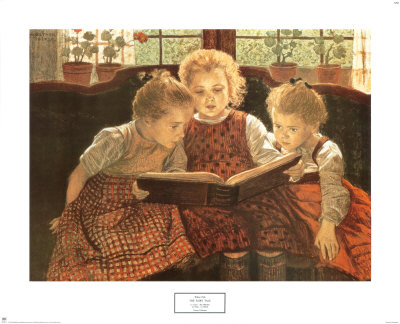
     *my favorite painting: The Fairy Tale by Sir Walter Firle, via art.com*

    And that's that. three steps that I hope are helpful, plus an inordinate amount of rambling. I'd love to know your Whys and Whats and Hows; please share them in the comments! Then go grab your kids and read.

xo


February 3, 2012

Something For Us

   Running a shop for handmade goods, I feel like I'm always making things I love...and then selling them. Always making stuff for someone else. But this week, with thoughts of learning from great literature on my mind, I decided to make something-- one of my custom vintage windows-- for my family:


       Isn't it pretty? I wanted the words to look sort-of typographic, but also like they were cut from pages of  a very big book. I'm pretty happy with how it turned out. It's on our nature table now, but I envision it in our library in the Someday House.

       And now something for you: A thought on learning through literature in your family:

Reading is not an antidote for thwarting social illness. It is not a tool with which to conquer space. It is not a thing we do to children. A child needs to be plunged into the world of literature in order to experience sound, emotion, and self. There is a certain urgency in young parents cuddling their children in the first year of life and sharing with them the cadence of Mother Goose rhymes, the rhythm of simple poetry, and the vigor of prose. To what end? Surely not to give them instruction.
It is true that the experience of hearing good literature, of seeing one’s parents read, of participating in family-in-the-round creative dramatic activities based on “Henny-Penny” or “Jack Be Nimble” will go a long way toward giving children a head start in learning to read.
But the primary purpose of reading to your child early in his life is not to provide quantities of anything for his future learning; rather, it is to insure a quality experience in your earliest parent-child relationships. The fact that he will be preparing himself for the later discipline of having to read is secondary. Reading experiences for children in the first three years of their lives must not be for instructive purposes; they should be for the opportunity of mother, father, and child’s sharing time, sound, and delight with one another.
xo

January 17, 2012

Book Love, Again

I've been working recently on preparing a class for our church's women's organization on helping parents find good literature for their kids. 
"Good literature" being, by my definition, books that not only foster a love of reading and inspire imagination, but also help kids to develop attributes like empathy, understanding, and kindness, a sense of justice and fairness, hope and courage, and an awareness of worlds outside their own sphere of existence. Books that are not overtly commercial (dumbed-down versions of children's movies on paper) or blatantly sententious. Books that teach subtle life lessons by drawing readers into the experiences of the characters and letting us feel their happiness and sadness and joy and pain. Basically, books that speak to and uplift the soul, in a very small, or sometimes, a very big way. And that's how I define good literature for myself as well.

I've been happily using this class as an excuse to do an abundance of reading...re-reading some of my childhood favorites, reading for the first time some classics I either never got to as a kid or just don't remember, and having lots and lots of read-aloud story time with the kiddos. (Yay!)

Today, I fell in love with a book again. 


This happens to me every now and then. Whereas my usual lit-loves tend to happen at first sight, however, this one took a little time. I was open and had high expectations (for pete's sake, it's Arnold Lobel- it can't stink). But it took me a couple of pages before the beauty of this simple story hooked me.
 The tale is about a young elephant who goes to stay with his very old uncle when his mother and father are lost at sea. Okay. Simple enough. But the depth of emotion with which the story is told...the surprising level of humanity and compassion to be found in Uncle Elephant's actions in caring for his nephew quite honestly moved me to tears. 
Here, my friends, is good literature for kids.
A story that shows without telling, teaches without preaching, touches hearts and plants seeds of compassion and kindness while engaging young minds in the infinite possibilities of what might happen next.
It's the kind of literature I hope I'm writing.

There will be a book list. Possibly a very long and absolutely not all-inclusive one. But I will share it for sure, as well as a plethora of helpful links and information on children's books for those who are interested.
Now go read some good books with your family (and share your recommendations in the comments please!).

xo

p.s. If you happen to click the 'Arnold Lobel' link and Wikipedia (I love me some Wiki) comes up as a black screen, here's why: http://www.huffingtonpost.com/2012/01/18/sopa-blackout-internet-censorship_n_1211905.html I've written to my congressman. Have you contacted yours?

January 13, 2012

Paper Blossoms, Among Other Things...

I'm pretty dang excited about this folks.


If you're a regular reader here, you've probably picked up on my love of old books.
I read them, use them as home decor, build stuff out of them, and use the pages for all kinds of art-type ventures.


So after Christmas, when I was left with the inner workings of about a billion (okay, eleven) books after my whole recycled-cover-journal project, I wanted to make use of those lovely yellowed pages in a new way.


And Paper Blossoms, a whole new division of my shop and aspect of my craft-tacular repertoire was born.


I love them. They are time-consuming to make and I poked my thumb with a milliner's needle more than once in the process, but still, I love them. 
So what do you think?
Both the bouquets, the wreath and a variety of the hair pins will be available in my shop sometime this weekend.  As will at least one of the Other Things (as promised in this post's title) that my abundant supply of book pages inspired:


 This Is the House That Jack Built
Nursery Decor Set


The frame tells the entire story, from the malt to the maiden to the farmer who sowed the corn, and the bunting banner coordinates with black-and-white illustrations from the same vintage book.

Not to toot my own crafty horn or anything, but this set seriously makes me want to have another baby, just so I can use it to decorate the nursery. 
Toot.Toot

And the ideas keep coming, so keep checking in. I'd love to share more.

xo